eYssen Cloud
The Green Odoo Cloud: fast, efficient, and future-proof
Business digitalization is not only about efficiency – it’s about sustainability too. That’s why eYssen Cloud solutions are built on the latest energy-efficient ARM-based Ampere server processors, the same architecture that powers Apple’s M-series devices.
What does this mean for your business?
Sustainability
Up to 50% lower energy consumption, reduced CO₂ footprint, a real contribution to a greener future.High performance
Seamlessly serving hundreds or even thousands of Odoo users with fast response times.Future-proof technology
Built on ARM / Ampere foundations, stable and supported for the long term.Flexible scaling
Increase CPU cores and memory on the fly, with zero downtime.Cost-efficient operation
Thanks to our modern infrastructure, you get more performance for the same price.This is not just another Odoo cloud!
It’s a fast, green, and future-proof business platform that scales with your company’s growth.
 Powered by Oracle Cloud Infrastructure
Admin Console
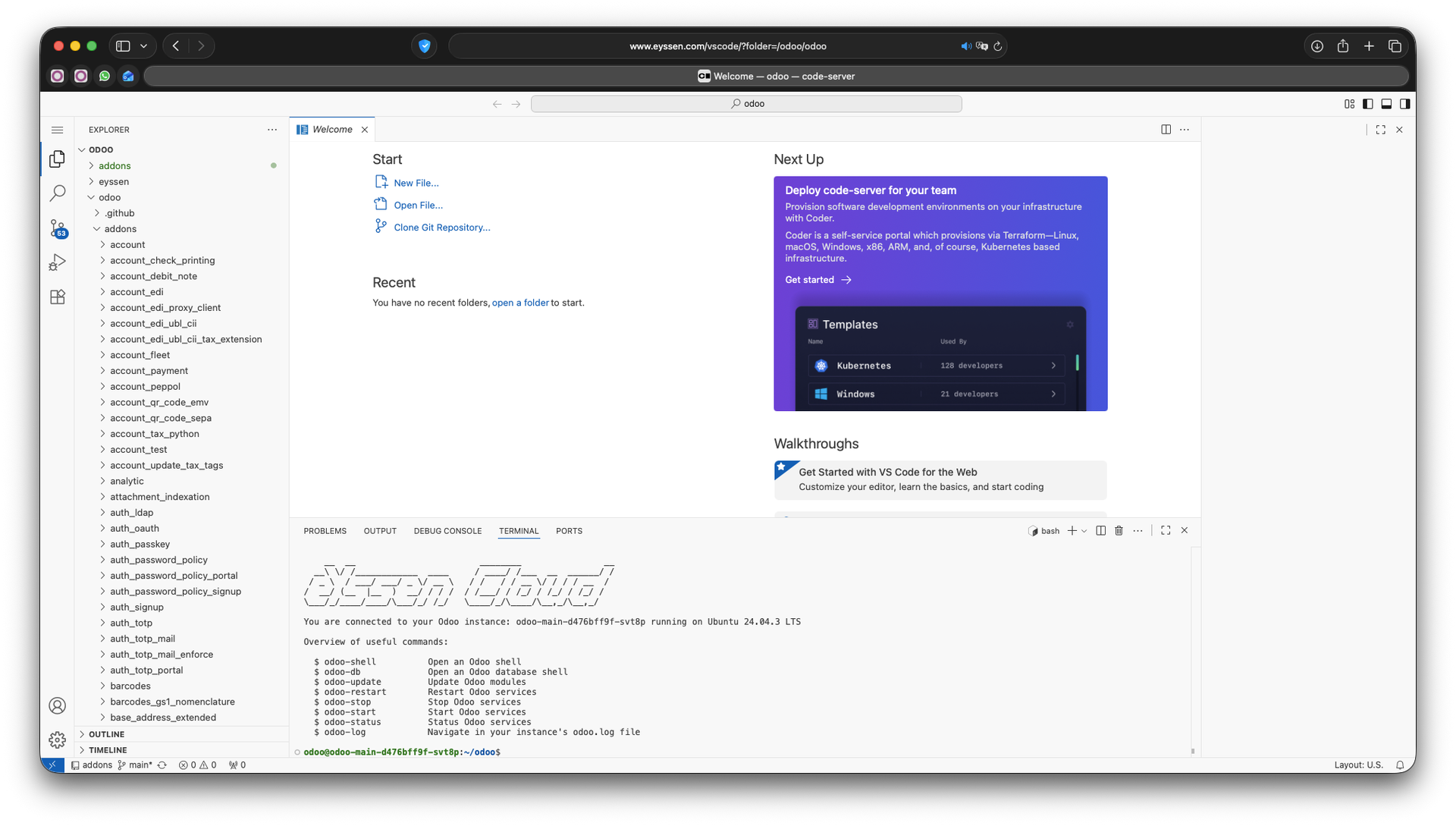
The eYssen Cloud Admin Console is more than just an administration interface - it's a complete, managed development environment instantly accessible from your browser. Our goal is to make development and administration as simple, fast, and flexible as possible.
Browser-Based IDE (OpenVSCode-Server)
Instant Development: The Console is built upon the popular OpenVSCode-Server technology, providing you with a full-featured, rich IDE (Integrated Development Environment) directly in your browser.
Full File Access: Easily navigate and edit all files and configurations belonging to your Odoo system.
Convenient Operations: Efficiency is boosted by the built-in Drag & Drop functionality, allowing you to easily upload files from your local machine to the server.
Version Control Freedom
Integrated Git Support: The Admin Console fully supports the Git version control system. The integrated command line and VS Code's Git features allow for quick code commits, branch management, and merging.
Flexible Choice: We are not tied to a single provider. Whether you use GitHub, GitLab, Bitbucket, or any other Git repository, it can be easily integrated and managed from the Console.
Odoo-Optimized Shell and Shortcuts
Pre-Configured Shell: The Console includes a built-in shell (command-line interface) access that runs inside the Kubernetes Pod, connecting directly to your Odoo environment.
Pre-made Commands (Shortcuts): To accelerate development work, we provide pre-built, Odoo-specific commands(e.g., database update, module installation, log file viewing, etc.). This minimizes errors and saves significant time.
Direct Database (PostgreSQL) Access
VS Code Plugins: The Admin Console (VS Code) supports specialized plugins for PostgreSQL access, allowing you to browse tables, run queries, and inspect data via a user-friendly Graphical User Interface (GUI).
Shell Access: For advanced users, the psql client is available directly from the shell, granting complete, low-level freedom for database administration and troubleshooting.
Advanced Management & Monitoring Tools
Log & Monitoring Access: Get direct links or embedded views for analyzing system logs and monitoring data, which is crucial for quick debugging, performance optimization, and identifying system bottlenecks.
Environment Switching: Use the interface to quickly switch between your stable production environment and isolated development/testing environments (branches), maintaining separation and safety.
Seamless Integration with GitOps Architecture
Configuration as Code: The Admin Console operates within our GitOps-driven architecture (based on Kubernetes). Any changes you commit and push via the Console are reflected in your Git repository, ensuring your infrastructure and application configuration is always synchronized with your codebase.
Controlled Deployments: This seamless integration ensures that every deployment is traceable, repeatable, and aligned with your version control system, guaranteeing a robust and stable environment for your Odoo installation.
Available Regions

- France Central (Paris) - Available upon request
- France South (Marseille) - Available upon request
- Germany Central (Frankfurt) - Available now
- Italy Northwest (Milan) - Available upon request
- Italy 2 - Coming soon
- Netherlands Northwest (Amsterdam) - Available upon request
- Serbia Central (Jovanovac) - Available upon request
- Spain Central (Madrid) - Available upon request
- Spain 2 - Coming soon
- Sweden Central (Stockholm) - Available upon request
- Switzerland North (Zurich) - Available upon request
- UK South (London) - Available upon request
- UK West (Newport) - Available upon request
- Israel Central - Available upon request
- Israel 2 - Coming soon
- Kenya - Coming soon
- Morocco 1 - Coming soon
- Morocco 2 - Coming soon
- Saudi Arabia West (Jeddah) - Available upon request
- Saudi Arabia Central (Riyadh) - Available upon request
- South Africa Central (Johannesburg) - Available upon request
- UAE East (Dubai) - Available upon request
- UAE Central (Abu Dhabi) - Available upon request
- Australia East (Sydney) - Available upon request
- Australia Southeast (Melbourne) - Available upon request
- India West (Mumbai) - Available upon request
- India South (Hyderabad) - Available upon request
- Indonesia North (Batam) - Available upon request
- Japan East (Tokyo) - Available upon request
- Japan Central (Osaka) - Available upon request
- Malaysia - Coming soon
- Singapore (Singapore) - Available upon request
- Singapore West (Singapore) - Available upon request
- South Korea Central (Seoul) - Available upon request
- South Korea North (Chuncheon) - Available upon request
- US East (Ashburn) - Available upon request
- US Midwest (Chicago) - Available upon request
- US West (Phoenix) - Available upon request
- US West (San Jose) - Available upon request
- Canada Southeast (Montreal) - Available upon request
- Canada Southeast (Toronto) - Available upon request
- Mexico Central (Querétaro) - Available upon request
- Mexico Northeast (Monterrey) - Available upon request
- Brazil East (Sao Paulo) - Available upon request
- Brazil Southeast (Vinhedo) - Available upon request
- Chile Central (Santiago) - Available upon request
- Chile West (Valparaiso) - Available upon request
- Colombia Central (Bogota) - Available upon request
How is eYssen Cloud structured?
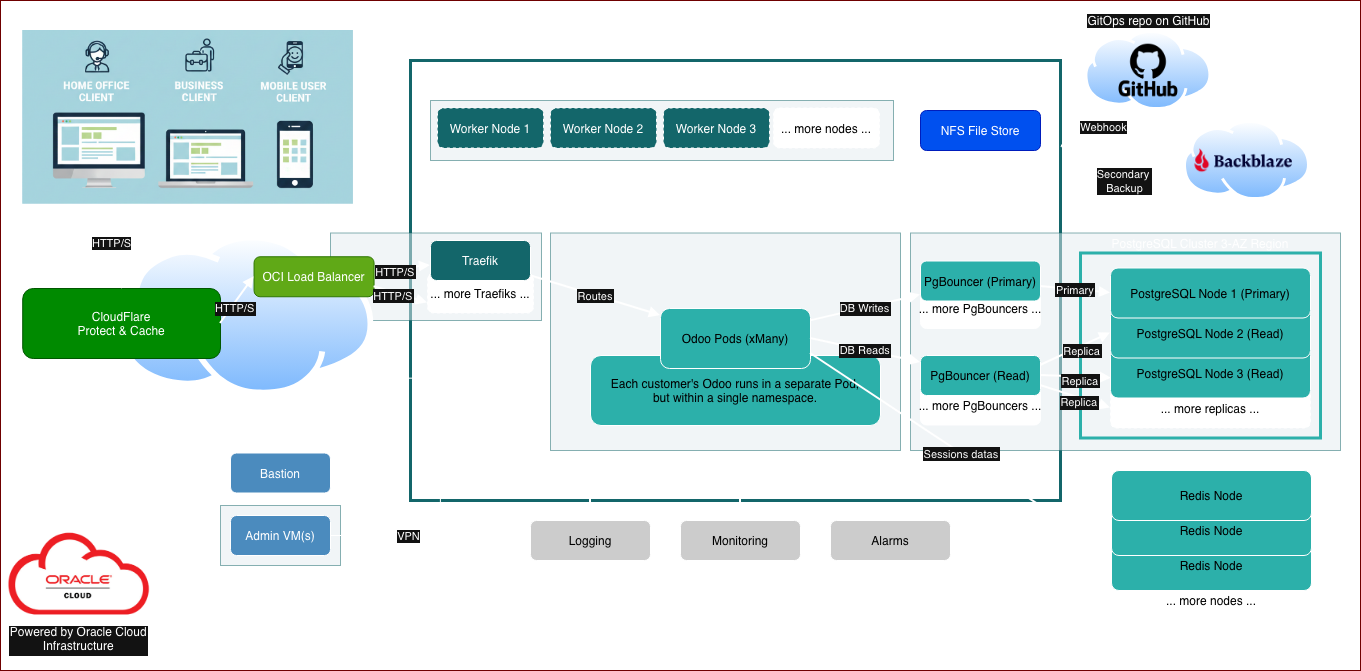
What are these technologies? - FAQ
The Oracle Cloud Infrastructure (OCI) is Oracle's cloud platform, designed for enterprise workloads—especially databases and mission-critical applications. In addition to classic IaaS services (compute, storage, network), OCI also offers managed platform services such as Autonomous Database, Container Registry, Kubernetes (OKE – Oracle Container Engine for Kubernetes), Functions (serverless), as well as a comprehensive set of observability and security tools (Logging, Monitoring, Vault, WAF).
Its networking model is built on "VCN" (Virtual Cloud Network), featuring fine-tunable subnets, route tables, security lists, and network firewalls. This design simplifies the hybrid interconnection of cloud and on-premises environments (FastConnect, IPSec VPN). One of OCI's strengths is its predictable performance and value for money: Bare Metal and flexible "Flexible VM" formats ensure high bandwidth and low latency, while "Resource Manager" and "Cloud Shell" facilitate Infrastructure as Code (IaC) management.
The platform provides built-in Identity and Access Management (IAM), detailed cost monitoring, and rigorous compliance certifications that support the requirements of regulated industries. Oracle's goal is to provide customers with a stable, secure, and open-standards-based environment where traditional enterprise workloads and modern, cloud-native applications can run efficiently side-by-side.
Kubernetes (K8s) is an open-source container orchestration system that automates the deployment, scaling, updates, and self-healing of containerized applications. Its basic units are Pods (a group of containers) that run on the cluster's nodes. The desired state is described in a "declarative" manner (Deployment, StatefulSet), and Kubernetes continuously works to ensure the running system matches this state.
Service access is handled by Service and Ingress resources, configuration and secrets by ConfigMap and Secret, and persistent data by StorageClass and PersistentVolumeClaim. The advantage of Kubernetes is that it provides a unified runtime layer from development to production: the same description (YAML/Helm) can be reused across multiple environments, and Horizontal Pod Autoscaling (HPA), rolling updates, and rollbacks are natively supported.
Access can be finely controlled with RBAC and namespaces. The observability ecosystem (Metrics Server, Prometheus, Grafana, Loki, OpenTelemetry) provides a complete picture of the system's health. Extensibility is ensured with Operators and CRDs, while Helm charts and GitOps tools (e.g., Argo CD) facilitate version-controlled, automated deployment. As a result, Kubernetes is an ideal foundation for microservices architectures, highly available systems, and rapidly scalable, cloud-native applications—whether on bare metal, in a multi-cloud environment, or as a managed service (such as OCI OKE).
Redis is an open-source, high-performance, in-memory data structure store widely used as a cache, message broker, and persistent store. Storing data exclusively in the server's RAM ensures extremely fast read and write speeds, minimizing latency, while optional disk synchronization (persistence) guarantees data durability.
Redis is much more than a simple key-value store; it natively supports complex data structures such as lists, sets, sorted sets, and hash tables, making it incredibly versatile in modern applications. It is an ideal choice for tasks that require high availability and lightning-fast response times, such as real-time leaderboards, counter management, and API response caching.
Through its built-in replication and clustering capabilities, Redis is perfectly suited to serve as the caching layer for high-traffic, cloud-native applications orchestrated by Kubernetes and running on OCI. This reduces the load on the primary database, and it is especially suitable for the high-speed and scalable storage of user session data in the Odoo system.
Backblaze is an American cloud storage and data backup company founded in 2007 in San Mateo, California. Its main products include a computer backup service and the B2 Cloud Storage service, both available to business and personal users. B2 Cloud Storage is a low-cost, high-performance cloud object storage service designed for developing various applications, handling media files, creating backups, and supporting Artificial Intelligence workflows.
Backblaze is committed to data security, offering numerous security features, including robust encryption and the option to use private encryption keys. The company operates multiple data centers in the United States and Europe, ensuring reliable and fast data access for its customers worldwide.
Cloudflare is an American technology company that provides content delivery network (CDN) and cloud-based security services. Its services include protection against DDoS attacks, reverse proxying of web traffic, and domain name service (DNS). Cloudflare's goal is to improve the security, performance, and reliability of the internet.
The company's global network is present in over 330 cities in more than 120 countries, enabling fast and reliable data transfer worldwide. Cloudflare's services are used by many businesses, non-profit organizations, and individuals to enhance the performance and security of their websites and applications.
Among the services offered by Cloudflare is its Content Delivery Network (CDN), which speeds up website loading times by storing static content on servers located in different parts of the world. Additionally, the company provides DDoS attack protection, preventing service outages caused by malicious traffic. Cloudflare is committed to improving internet security and performance and continuously develops its services to meet modern web challenges.
OpenVSCode Server is an open-source project that makes the popular Microsoft Visual Studio Code (VS Code) editor available in a web environment via server-side execution. Essentially, it runs a full-featured VS Code environment on the remote machine (in this case, on OCI, within a Kubernetes Pod), which users can access through any modern web browser.
This solution allows developers to access, edit their code, and run their debugging tools without having to locally install heavy development dependencies, as all compute tasks occur in the cloud. OpenVSCode Server supports VS Code extensions, the built-in terminal, Git integration, and language-specific services.
Since the development environment runs directly in the Kubernetes container where the code is also deployed, it guarantees consistency between the development, test, and production environments. Access to the service is provided via the Cloudflare CDN, which not only improves speed but also offers built-in protection against potential attacks, while the underlying OCI infrastructure provides a scalable and secure foundation for development workflows.
GitOps is an operational framework for delivering and managing cloud-native applications that uses Git as the single source of truth for declarative infrastructure and applications. The essence of GitOps is ensuring that what you declare in the Git repository—the desired state—is exactly what is running in your environment—the actual state.
How GitOps Works
GitOps is built upon four core principles that ensure automatic and controlled deployments. Firstly, the entire system, including infrastructure, applications, and their configurations, is declaratively described. Secondly, the system's desired state is stored in Git, guaranteeing a complete change log and the ability to roll back to any previous state. Thirdly, software delivery is executed by an automated process that applies the desired state changes to the environment. Finally, the crucial fourth element is the software agent (Controller), which continuously monitors both the Git repository and the cluster's actual state. This agent is responsible for ensuring that the actual state continuously converges toward the desired state defined in Git.
ArgoCD: The GitOps Implementation
ArgoCD is a popular, Kubernetes-native Continuous Delivery (CD) tool that perfectly fits within the GitOps framework. ArgoCD serves as the software agent running inside your cluster. Its operation is based on the pull model: it constantly monitors the target Git repository for changes to the desired state while simultaneously monitoring the current state of the Kubernetes cluster. When it detects a drift between the two states, the application enters an "Out of Sync" status. If configured for automatic synchronization, ArgoCD automatically applies the changes from Git to the cluster, restoring the desired state. This creates a powerful self-healing mechanism. This approach is highly secure, as the CD tool does not require direct write access to the cluster (unlike a push model), and every environment change is an auditable consequence of a Git commit.